
Last Updated on 5 October 2025 at 14:54
In financial services like FinTech and WealthTech, as well as other regulated industries, the difference between high availability (HA) and fault tolerance (FT) is not an academic one. Uptime becomes part of the architecture. It is a decision that shapes architecture, operating models, and budgets. I’ve seen trading desks stall because “redundancy” was confused with “silence.” I’ve also seen millions invested in parallel systems that no one had the DevOps maturity to maintain.
As a Solutions Architect, my approach is based on the common sense and financial and technical constraints: continuity must obey strategy. The board sets a risk appetite. Regulators define constraints. My job to translate that into systems that work.
HA, FT, and DR are not buzzwords but execution choices with real-world costs.
Here is a short reminder, as we will detail these notions later in this publication.
- HA, or high availability, is the discipline of using redundancy and failover to reduce downtime.
- FT, or fault tolerance, goes further, running parallel systems so that failures are invisible.
- And finally, DR, or disaster recovery, accepts downtime but guarantees restoration.
Every board presentation has the same slide: “99.95% uptime guaranteed.” Yet, behind the number lies architecture, operational complexity, and ultimately, choices. A guarantee of availability is not a promise of silence. In regulated industries — from banking to pharmaceuticals — that difference determines whether compliance holds or collapses. I’ve spent my career watching teams misinterpret resilience vocabulary, and then watching budgets evaporate when outages prove the illusion wrong.
Conventional approaches treat continuity as a service bought from the cloud vendor. Tick the SLA, check the compliance box, move on. In practice, continuity is not sold. It is engineered. Azure may provide the constructs, but it is the architect and the DevOps team who define whether availability is comfort, certainty, or recovery.
In my experience, I noticed that resilience should no longer be reduced to percentages of uptime. With hybrid-cloud, AI-driven monitoring, and systemic cyber risks, the future is about predictive resilience. Instead of building more redundancy, systems should learn to anticipate disruption and adapt dynamically. That shift will demand a different mindset — continuity not as insurance, but as intelligence.
Table of Contents
1. High Availability: Resilience Through Redundancy
High availability (HA) is about minimizing downtime through redundancy and failover. A service may hiccup, but automation restores it within seconds. In Azure, this typically refers to Availability Sets, Availability Zones, and managed PaaS services that include built-in replication.
From my experience in FinTech and WealthTech:
- Core banking portals and portfolio reporting dashboards are perfect candidates for HA. They can tolerate seconds of interruption if customers are informed.
- In Wealth Management systems, daily position reporting or portfolio valuation can run on HA models — uptime is critical, but silence is not absolute.
- DevOps maturity is key. Without monitoring, alerting, and automated failover pipelines, HA is only a design on paper.
HA is cost-efficient. It increases resilience without doubling everything. It’s the right fit for workloads where reputation matters, but microsecond continuity is not a systemic requirement. However, HA is often over-promised as “never down.” In practice, the service may flicker, but governance teams rarely notice until it hits customers. That gap is where architectural honesty matters.
Indeed, high availability is the workhorse of enterprise architecture. It doesn’t promise silence, but it keeps most systems running most of the time. In practice, it means building redundancy — multiple instances across racks, zones, or regions. Failures are expected, absorbed, and corrected. Think of it as shock absorbers in a car: you feel the bump, but the vehicle continues to move. In FinTech, HA ensures that daily portfolio valuations run reliably; in manufacturing, it enables ERP systems to keep production lines fed with data even when a database node fails.
In Azure, the textbook of a conventional solution and HA pattern is Availability Zones or Availability Sets for VMs, combined with load balancers and PaaS redundancy. Monitoring through Azure Monitor or App Insights triggers failovers, while Logic Apps can automate recovery workflows. These are stable, predictable, and cost-efficient patterns.
However, too many organisations treat HA as “good enough” without rehearsing its failure paths. They deploy across zones but never test the failover. They assume uptime equals resilience. My perspective is that HA must evolve towards self-healing architectures — not just failover, but automated diagnostics and recovery pipelines. The DevOps pipeline itself should become resilient: infrastructure-as-code that can recreate environments instantly. HA in the future will be less about static redundancy and more about dynamic reconstitution.
2. Fault Tolerance: Silence Without Compromise
Fault tolerance (FT) is the hard guarantee of silence: systems continue operating without any interruption. Failures are invisible because active-active systems mask them completely. This is where architecture collides with cost. In practice, fault tolerance is architectural overkill for most workloads — but indispensable for some.
In trading systems, even a single millisecond of interruption can result in lost orders and regulatory risk. In healthcare, a monitor flicker can endanger lives. FT is built on parallelism: active-active systems, synchronous replication, and multiple engines running at once. It’s the equivalent of flying a plane with two engines — if one fails, the other already carries the load.
From my experience in financial processes for banks and financial institutions:
- Order execution systems in trading platforms cannot afford flickers. One lost transaction is regulatory exposure.
- Payment rails, clearing systems, and market connectivity require fault tolerance — as much as silence, not comfort.
- Achieving this means synchronous replication, parallel workloads across regions, and deterministic failover paths.
A conventional solution in Azure is that FT requires active-active clusters, often geo-distributed, with synchronous replication across regions. Load balancers route traffic seamlessly.
In DevOps, where I have extensive expertise, FT only works if the operational discipline matches the architecture. Running active-active clusters demands mature CI/CD, blue-green deployment pipelines, and automated testing across failover boundaries. Without that, the architecture becomes rigid debt. In practice, fault tolerance requires blue-green deployments and rolling updates, ensuring that no interruption is visible to end users. Of course, FT is expensive not only in hardware per se, but especially in the operational discipline.
At the same time, the obsession with FT can be as dangerous as its neglect.
I’ve seen banks spend millions on fault-tolerance designs they couldn’t operate. The hidden cost is more on the human side: DevOps teams burn out maintaining complexity that isn’t needed. My prediction is that FT will increasingly become a managed service layer, offered by vendors as a turnkey resilience solution for payments, AI workloads, or real-time analytics. But boards must stop treating FT as a trophy architecture. It should be applied only where strategy dictates zero tolerance for failure. Anything else is waste disguised as resilience.
3. Disaster Recovery: Restoration, Not Continuity
Disaster Recovery (DR) is often confused with High Availability (HA). However, it is not about seamless continuity but about restoring systems after catastrophic failure. Downtime is accepted, and recovery is guaranteed.
From my project experience:
- Back-office reconciliation, HR systems, or archiving can rely on DR. Minutes or hours of downtime are tolerable.
- In Azure, DR means Site Recovery, geo-redundant storage, or paired regions. You define RTO (Recovery Time Objective) and RPO (Recovery Point Objective), and test them.
DevOps maturity is again decisive: DR plans fail if they are not regularly rehearsed. I’ve run simulations where teams thought they had DR, but the failover scripts were untested, or the secondary region was outdated. DR without rehearsal is fiction.
In practice, Disaster Recovery (DR) is misunderstood. It doesn’t mean uninterrupted service; it means planned downtime and guaranteed recovery. It is more about insurance, not resilience per se. In execution, it appears to be secondary data centres, cold standby regions, or asynchronous backups. DR is where CFOs and CIOs negotiate: what is the maximum tolerable downtime, what data loss can be accepted? In Wealth Management, reconciliation systems can rely on DR: they don’t need 24/7 silence, but they must recover by morning.
As a conventional solution in Azure, the disaster recovery is codified through Site Recovery, geo-redundant storage, and paired regions. Enterprises define RTO (Recovery Time Objective) and RPO (Recovery Point Objective) to determine how quickly they can recover and how much data loss is acceptable. Teams test failovers quarterly, ideally simulating complete region outages.
But in my experience, too many DR plans exist only in binders. They’re rehearsed once, then forgotten. My perspective is that DR must evolve from “afterthought insurance” to integrated resilience-as-code. Recovery scripts should be embedded in pipelines, tested alongside deployments, and continuously validated.
The future of DR is not separate from DevOps, it is DevOps. Instead of dusty theoretical plans, teams need a living, automated resilience playbook.
4. Execution Choices: When Strategy Meets Systems
The choice between high availability (HA), fault tolerance (FT), and disaster recovery (DR) is more about how much interruption the business can tolerate, how much silence it is willing to pay for, and how much recovery time it can accept. In other words, it is about risk appetite and execution capability, more than technology.
Here are some examples:
- Risk Appetite. A trading desk has zero tolerance for downtime, while a reporting portal can absorb a flicker.
- Cost Boundaries. HA adds instances; FT duplicates everything; DR is insurance. Each model has a very different cost curve.
- Regulatory Context. Regulators no longer accept uptime percentages but tested, auditable continuity — and they will ask for evidence.
- Operational Capacity. A design is only as strong as the DevOps team running it. FT without operational maturity is unsustainable debt.
This is where my execution philosophy applies: continuity is not a basic checkbox in procurement but an architectural negotiation between governance demands, budget limits, and operational capacity.
Boards often ask, “how much downtime can we afford ?” CIOs translate that into architecture. My role has typically been to mediate this tension: demonstrating that HA is suitable for portals, FT is necessary for trading, and DR is sufficient for other systems. The trick is to align and build systems that adhere to strategy and field realities.
As a conventional solution, enterprises map workloads into tiers:
- Tier 1 = mission-critical (FT),
- Tier 2 = critical (HA),
- Tier 3 = important (DR).
Architecture is aligned with these tiers, and this classification is standard in highly regulated industries, such as banking.
At the same time, this tiering model is static. It assumes workloads remain fixed in importance. But in digital organisations, criticality shifts. A portal can suddenly become systemic if regulators rely on it for oversight. My argument is that continuity models must be dynamic, not static. Architectures should be flexible: workloads can be dynamically moved from HA to FT based on demand, risk signals, or regulatory triggers. This is where AI-driven monitoring and adaptive cloud deployments will redefine execution.
5. Practical Patterns in Azure
When it comes to implementation, the patterns are familiar, but the way they are lived in execution makes all the difference. High availability is typically achieved through Availability Zones and geo-redundant databases, supported by load balancers that distribute demand across instances. On paper, these constructs seem straightforward; in practice, they only matter when they are actively tested. Monitoring through Azure Monitor and Logic Apps, coupled with alert-driven playbooks, turns redundancy into something more than a diagram. Without that operational discipline, “zones” and “redundancy” remain buzzwords rather than capabilities.
Fault tolerance demands a heavier hand. Here, resilience is built on active-active scale sets, synchronous replication across regions, and deployment practices such as blue-green rollouts that mask change from the end-user. It is costly, both in terms of infrastructure and human skill, but essential in environments where silence is non-negotiable. The elegance of fault tolerance lies not in its architecture but in its invisibility — failures happen, but no one notices. That silence, however, must be engineered and maintained with relentless precision.
Disaster recovery, by contrast, is about accepting interruption and committing to recovery. In Azure, this often involves automating Site Recovery, scripting failover procedures, and rehearsing them every quarter. The discipline here is not in the technology but in the rehearsal: defining recovery objectives, aligning them with business appetite rather than engineering optimism, and ensuring that the scripts are living documents, not theoretical exercises. Recovery is a verb. Without constant practice, it becomes nothing more than a slide in a continuity deck.
For High Availability:
- Use Availability Zones, SQL geo-redundancy, and load balancers.
- Automate monitoring and failover through Azure Monitor and Logic Apps.
- Build alert-driven DevOps playbooks.
For Fault Tolerance:
- Active-active scale sets with load balancing.
- Synchronous replication across regions.
- Blue-green deployments to minimise human risk.
For Disaster Recovery:
- Automate Azure Site Recovery.
- Script failover and rehearse it quarterly.
- Define RPO/RTO and align them with business appetite more than engineering theory.
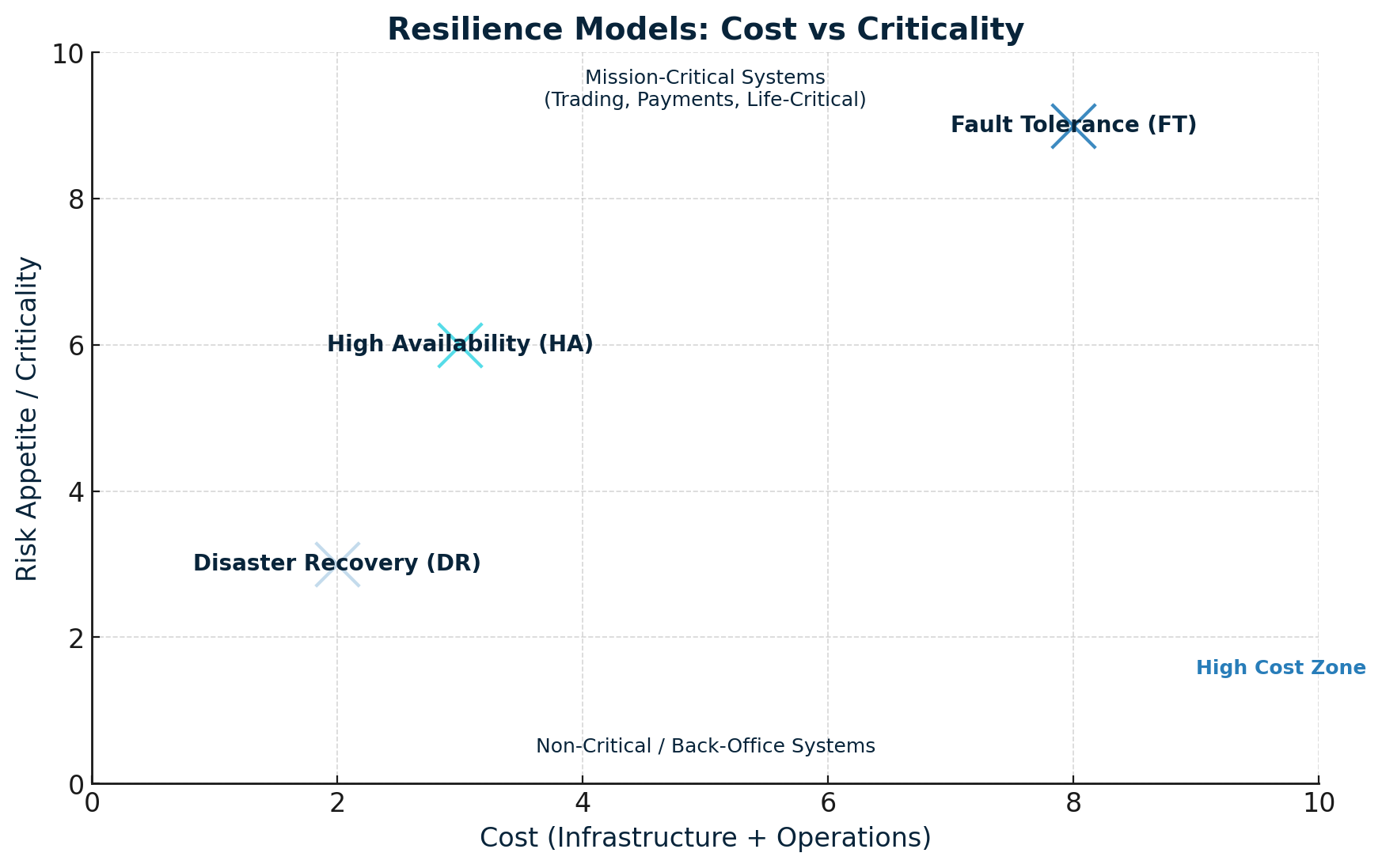
Azure provides the building blocks, but it is up to architects to use them coherently. I’ve seen enterprises scatter HA, FT, and DR patterns randomly across workloads without a unifying strategy. The result is technical debt disguised as resilience. A coherent execution model means aligning Azure constructs (Zones, Site Recovery, Load Balancers) with business tiers, DevOps pipelines, and regulatory requirements. Microsoft documentation is full of reference architectures.
However, following Microsoft’s reference diagrams blindly is not field execution. Real resilience means simplifying architectures as per customer needs, not multiplying them.
My view is that the future will converge towards resilience blueprints — standardized, modular architectures that are tuned to governance appetite and customer needs.
Instead of custom designs every time, we’ll see libraries of tested continuity modules that DevOps teams can deploy as code. This approach will lower cost, reduce complexity, and finally bridge governance vocabulary with execution reality.
6. Lessons from Wealth Management Systems
In FinTech and WealthTech, resilience is more than uptime. It is about client confidence in numbers that must always be right.
Wealth Management platforms are case studies in continuity trade-offs. Client portals need HA — if they flicker, users refresh. Order execution systems demand FT — if they drop, reputational and regulatory exposure follows instantly. Reporting and reconciliation can run on DR — downtime is tolerable as long as end-of-day balances are restored. Over the years, I’ve mapped these distinctions into continuity tiers for banks, helping them allocate continuity budgets intelligently.
The mapping of risk appetite to architecture is where most transformations fail.
Most companies either overspend by demanding FT everywhere, or they under-fund by assuming HA is enough. Both mistakes stem from a lack of precision in continuity vocabulary. Moreover, most banks implement a tiered resilience model across their TAP (Temenos) or Avaloq systems: HA for portals, FT for trading, DR for reconciliation. They document this for regulators, audit it annually, and refer to it as resilience.
The reality is that many self-called “modern” Wealth Management systems are fragile monoliths. They cannot flexibly adopt HA or FT because their architectures predate modern cloud models.
My prediction is that WealthTech will shift towards modular, service-driven continuity — microservices that can each have their own resilience profile. Some modules run HA, some FT, some DR. This approach is more granular, but it’s also more honest — and more adaptable to evolving regulatory expectations.
Conclusion: Obeying Strategy Through Architecture
Resilience is not uptime. Resilience is not a feature that Microsoft sells as comfort. It is an outcome of architecture, DevOps maturity execution, and governance clarity.
My role as a solutions architect is to bridge the gap between boardroom strategy and engineering execution.
High availability, fault tolerance, and disaster recovery are not interchangeable words but trade-offs. Ignoring those trade-offs is the fastest way to build costly and fragile systems.
- If the strategy requires comfort, build with a focus on HA.
- If the strategy requires silence, fund mainly FT.
- If the strategy tolerates downtime, plan with DR in mind.
But beyond today’s models, we must anticipate tomorrow’s demands: predictive resilience, adaptive continuity, resilience-as-code. Architectures must not only survive past or potential failure; they also must learn from it.

FinTech Wealth Management expert with 30 years of successful track record, from Unicible/BCV to Odyssey and Temenos, plus hundreds of important banks across EMEA, APAC, and NAM.
► Background — from C-language code to C-suite in 30 years
• WealthSuite Triple’A Temenos TAP Plus expert
• crisis & change management
• complex multi-level project – program – portfolio management
• process architecture & governance, process optimization, BPO
• financial services software engineering FS FinTech
Career start as an innovative software engineer in startups ► to strategic advisory & turnaround for Tier1 & Tier2 Banks at senior C-level.
• T-shaped mastery of the latest key technologies, business, and operational practices in retail banking, asset management, core banking, PMS.
• Keen focus on improving productivity, client retention, and revenues through expertise in Program Management, Process Governance, and Optimized Delivery, augmented by know-how in complex issue resolution and value-driven E2E end-to-end implementations.
Temenos Practitioner accredited across WealthSuite and FrontOffice domains (FO, PM, TTI). Certified modules include Scripts & Formats, Implementation Methodology (T3TIM), Channels PM, APA Attribution, Constraint Management, Order Management, Data Security, WealthSuite Portfolio Management, and T24 Triple’A Interface. The Practitioner status anchors Didier’s capacity to operate as a Transformation Director, bridging certified product mastery with execution governance and program recovery.
Disclaimer —
The views and opinions expressed in this publication are those of the author, Didier Debbaut, and do not represent the views, positions, or policies of Temenos AG, its affiliates, clients, or partners. All information is shared in good faith and in the spirit of professional exchange, as part of an open, constructive contribution to the FinTech and WealthTech community.
Any technical references, opinions, or analyses are based solely on publicly available information and the author’s independent field expertise. They are offered for general informational and educational purposes only.
No confidential, proprietary, or non-public information related to Temenos products, clients, or business operations is disclosed or implied.
© Didier Debbaut — All rights reserved.


Learn when to choose High Availability, Fault Tolerance, or Disaster Recovery in Azure. Didier Debbaut maps costs, risks, and execution trade-offs.

Mixing #Agile with #Waterfall ? Think of it as a cake with the chocolatey structure of Waterfall and the creamy flexibility of Agile. The cherry on the cake is the best of both worlds, and this is how you can win at #software #development and #project #management.

The debate between Agile and Waterfall is not a zero-sum game. Each methodology has its merits and drawbacks, and the choice between the two is often dictated by the specific requirements and constraints of a project or program. However, for projects that demand both structure and flexibility, a hybrid approach can offer a balanced solution.
In practice, it is not about choosing between Waterfall and Agile; it’s about knowing when to use each. Structure and flexibility are complementary and not mutually exclusive. So, the next time someone tries to sell you on the “one true methodology”, remember: the most innovative solutions often come from combining the best of multiple worlds. It’s not about only waterfall or agile, but a lot of other methodologies, too.

Our latest publication explore the complex world of FinTech, focusing on the role of DevOps. Written by Didier Debbaut and Elena Debbaut, both experts in Software Wealth Management and Turnaround & Crisis Management, the piece aims to offer a comprehensive and nuanced understanding of DevOps’ strategic imperatives in the FinTech sector.
